
5 minute read

Reflections on Scotland’s Vision for 2048: ‘what if we got it right?’
Primary care will have a huge role to play, both in mitigating the climate impact of our services, and supporting patients to manage and prevent health effects of climate change. We know that those who are most vulnerable in society will be most affected by the climate crisis.
– Dr Katie Hawkins, RCGP Scotland’s Climate and Sustainability Clinician Representative
Primary care leaders and stakeholders gathered in Glasgow during Climate Week last month to explore how Scotland can build a more sustainable, resilient and equitable primary care health system in the face of climate change and widening inequalities.
September 2048 was chosen as the focal point for participants to imagine the primary care service of the future. By then, the effects of climate change will be even more evident and the NHS will be 100 years old.
The event, the first of its kind, took place on 23 September at the Technology & Innovation Centre, University of Strathclyde and was initiated by Dr Guy Pilsworth, Chair of Greener Practice Glasgow and a GP partner in Bearsden, Glasgow. It was made possible thanks to the hard work of a small, dedicated team, including representatives from DesignHOPES, the Royal College of General Practitioners Scotland, and Public Health Scotland.
Seventy people from a diverse range of backgrounds were invited, drawn largely from primary care and public health; representatives from local government, the third sector and an A&E consultant from secondary care were also among those taking part.
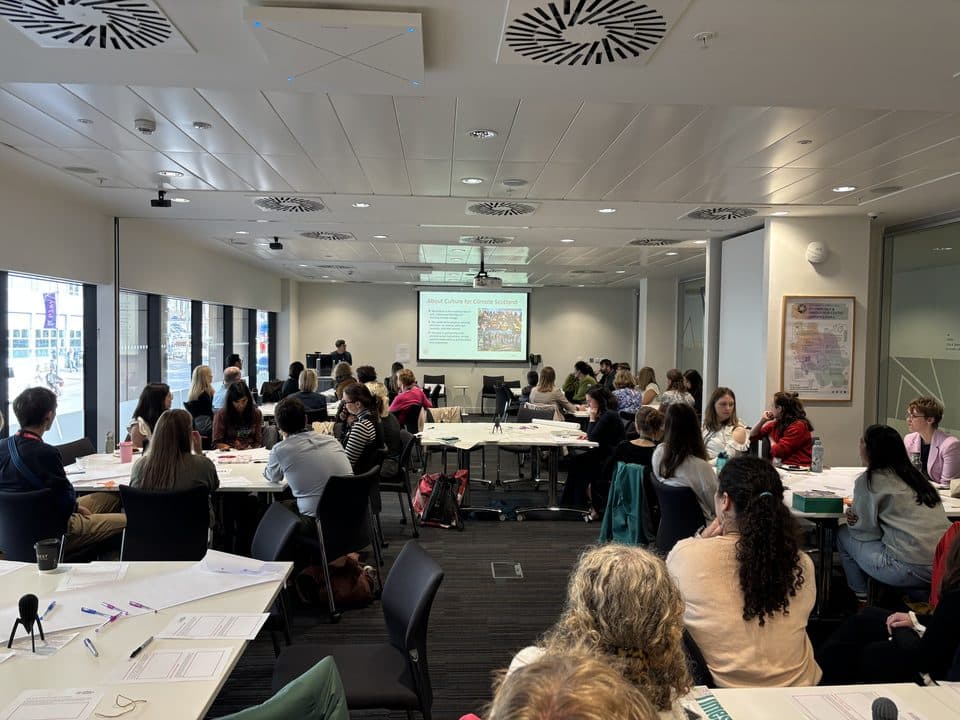
Speakers included Professor Sir Gregor Smith, Scotland’s Chief Medical Officer; Dr Mareike Kroll, who joined virtually from the World Health Organisation Europe Office in Bonn; and Dr José Chen, Lancet Countdown Europe. Attendees heard about the challenges NHS Scotland faces to reach Net Zero and adapt to climate change, informed by the latest climate-health evidence from the 2026 Europe Cities Report of the Lancet Countdown. This set the scene for the discussions that followed.
Facilitators challenged participants to look beyond today’s pressures and consider what kind of health system Scotland needs for the future – and strategies to turn the vision into reality. Scenarios were used to encourage a flow of creative solutions to complex problems. After a busy few hours, each group had developed a shared a poster of what they wanted in the future and a timeline for how to get there. Prevention and climate equity, green and social prescribing, food systems, and climate literacy and education were commonly identified themes.
Dr Pilsworth explains, ‘A group of us spent several months planning the event after an idea around more collaborative working sparked a fire in us all. The climate and nature crisis tends to evoke two typical responses in the NHS, one is despair and the other is often to pretend it isn’t happening. That’s partly because the problem can seem so vast and daunting. As an individual working within such a large system, it can feel difficult to make positive changes.
‘We wanted to offer people some hope and an alternative way of looking at things. We all felt that to tackle such a complex problem, we need better collaboration at a higher level to optimise our collective knowledge and experience. Groups of people tend to be much better at solving problems than individuals. Working together, we can shape the future.
‘The high level of consensus about the need for change and the need to collaborate, across sectors and disciplines, is clear and encouraging. Climate-health challenges cannot be addressed by health systems alone.
‘We are in the process of writing up a report on the day and plan to share this widely. This event was just the start: we are applying for funding to enable us to continue the conversation and turn ideas into policy, planning and practice.’
‘DesignHOPES is creating, prototyping and testing the tools, behaviours and systems needed for NHS Scotland to meet, and move beyond, urgent Net Zero goals and create a sustainable health and social care system. We’re delighted to be working across the sector and with primary care colleagues to ask what needs to change, and how design might help, to get it right for people and planet.’
– Prof. Paul Rodgers of the University of Strathclyde, and Co-Director of DesignHOPES
Dr Katie Hawkins, RCGP Scotland’s Climate and Sustainability Clinician Representative, said: ‘With the summer of 2026 being the hottest UK summer on record, climate change is not a challenge for the distant future. GPs are already seeing the effect on our patients’ physical and mental health. RCGP Scotland is advocating for bold actions now to protect our future.
‘As GPs we want what is best for our patients – and that means we must advocate for a primary care system that is resilient, sustainable and equitable.’
‘What if we got it right?’ is also supported by the Royal College of General Practitioners Scotland (RCGPScotland), Public Health Scotland, Design HOPES and the Glasgow Changing Futures programme.